Catalina Island SnorkelingIsla Catalina, Dominican Republic Check Availability

Catalina Island Snorkeling Trips, Dominican Republic

Two named reef stops sit off a 16.23 km² natural monument an hour out of Bayahibe, and Catalina Island snorkeling trips differ mostly in one number: how long they leave you in the water. Compare them on that, then check dates.

Updated September 2026

  • Isla Catalina, La Romana — not the California island
  • Rated 4.0 to 4.8 on GetYourGuide
  • Free cancellation up to 24 hours
Quick answer The two named reef stops, the trip that gives you two hours in the water, and the calendar that decides how busy the beach is

Catalina Island snorkeling means two named sites off the west shore of Isla Catalina in the Dominican Republic: The Wall, a drop-off the tourism ministry describes as over 100 ft, and The Aquarium, shallow at about 13 ft. Every listed way in is an organised boat trip — the island is uninhabited apart from an airstrip and there is no shore entry to buy. The trips compared here run from Bayahibe, La Romana or a Punta Cana hotel pickup, and they split on time in the water: two hours across both sites at one end, 45 minutes at The Wall at the other.

Key takeaways

The Catalina Island Snorkeling Trips We Compare

Every price here is the lowest adult shared-group rate shown on the GetYourGuide listing, read in September 2026 in US dollars, and every one of these trips can be cancelled free up to 24 hours before pickup with nothing paid at booking. The badge on the first card is our own verdict, not the platform's.

Small-Group Catalina Island Snorkeling Tour

Two hours across both named sites — an hour more than the next-longest listing, and $22 less than the dearest

★★★★★ ★★★★★ 4.8(57 reviews)· 8 – 10.5 hours

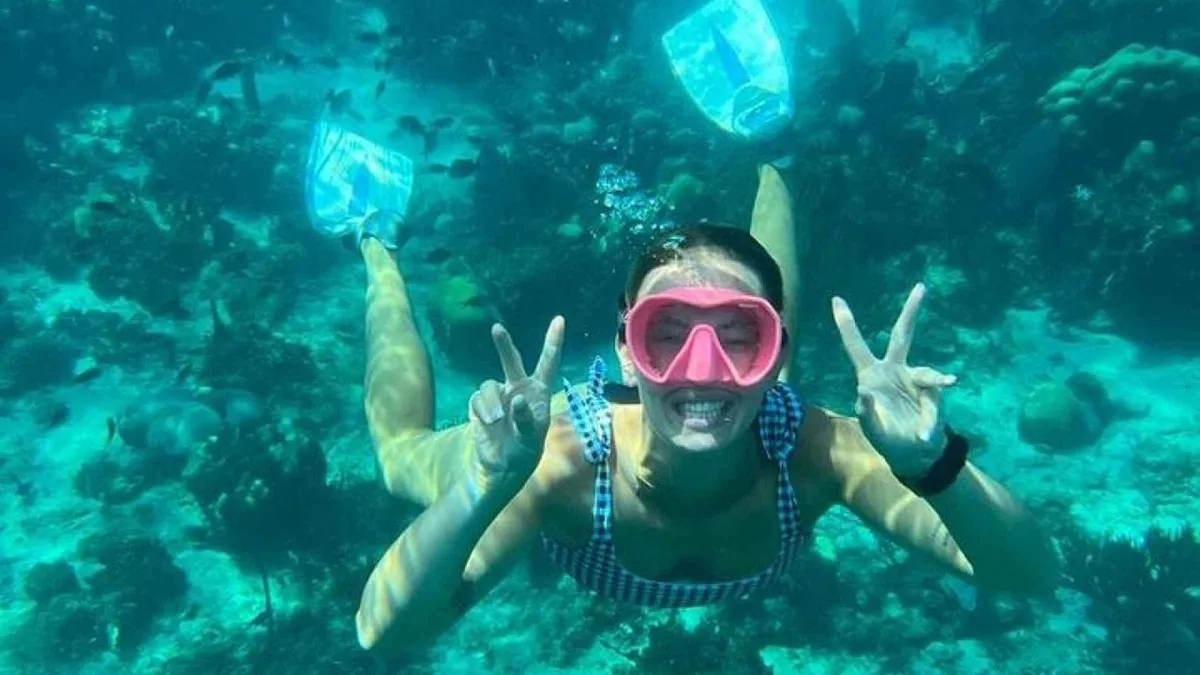
The only listing that puts you in the water twice and says how deep each stop is: The Wall at about 30 ft, The Aquarium at about 13 ft. A 45-foot engine boat capped at 30 passengers, two hours on the beach, and the Chavón River gorge on the run back to Bayahibe.

Cancellation
Free cancellation 24h
Operator
Dominican Attitude Excursions

Comfort Catamaran Snorkeling Trip to Catalina Island

★★★★★ ★★★★★ 4.0(64 reviews)· 7.5 hours

The listing with the clearest clock on it — sail at 09:00, 45 minutes at The Wall, 2.5 hours of buffet and sunbeds on the beach, Bayahibe again by 16:30. Guides work in six languages, and the reef stop is the only one, so it is a beach day with a snorkel attached.

Cancellation
Free cancellation 24h
Operator
Dominican Emotion

Full-Day Snorkelling Trip to Catalina Island from Punta Cana

★★★★★ ★★★★★ 4.0(79 reviews)· 11 hours

Eleven hours door to door, most of it free time on the sand — a bus to La Romana port, one coral stop on the crossing, then the island itself. It runs rain or shine, has the most reviews of any listing here, and its own access limits are worth reading before you book.

Cancellation
Free cancellation 24h
Operator
One Click Shuttles and Travel
Independent comparison — we sell nothing
Listings last checked: September 2026
Island facts checked against the Ministry of Environment and MITUR
Traveller feedback reviewed: 240+ reviews

Time in the Water Is the Column That Decides It

Most of these trips sell the same island, the same buffet and the same open bar. What separates them is the third column. Two hours covers both named sites at an unhurried pace; 45 minutes is one stop and a swim back to the ladder.

Trip Leaves from Time in the water Boat Rating Book
Our pick Small-group day Bayahibe / Punta Cana 2 hours, two sites 45-ft boat, max 30 4.8 (57) Check Availability Details
Quetzal catamaran Punta Cana / La Romana 1 h 15 min, two sites Catamaran, max 28 4.8 (9) Check Availability Details
All-inclusive day Punta Cana One stop, not stated Coach + catamaran 4.2 (33) Check Availability Details
Comfort catamaran Los Melones 45 minutes, The Wall Catamaran 4.0 (64) Check Availability Details
Full day, 11 hours Punta Cana One stop, not stated Bus + boat 4.0 (79) Check Availability Details

Free cancellation up to 24 hours before pickup on every trip listed here.

Two of the set state how long you are in the water and where; three describe "a coral reef stop" and leave the length open. That silence is not evidence of a bad day out — the two cheapest listings are beach days with a snorkel attached, and they are honest about the beach being the point.

Live Dates and Prices

Live availability for our pick straight from the booking platform. Prices on this page were read from the listings in September 2026 and are confirmed at checkout, not here.

Powered by GetYourGuide

Looking at one of the others? Quetzal sailing catamaran · All-inclusive day trip · Comfort catamaran day · Full day from Punta Cana

Which Catalina This Is, and What the Listings Get Wrong

Three islands in the Americas answer to Catalina, and the search results mix them constantly. This page is about the Dominican one — Isla Catalina, 2.4 km (1.5 mi) off the south-east coast between La Romana and La Altagracia, reached from Bayahibe.

A natural monument in its own right

The Ministry of Environment's own cartography for the island is headed Monumento Natural Isla Catalina, Ley 202-04, Decreto 571. The sheet gives a protected area of 16.23 km² — island plus surrounding water — with a 300 m buffer zone drawn around the boundary. That is a different legal object from Cotubanamá National Park, which several tour listings and even the Ministry of Tourism's own reporting name as the island's parent.

Both claims turn up in print, and the distinction is not pedantry: it is the reason your ticket line says "national park fee" while the map on the wall of the ranger post says something else.

What you will readWhere it comes fromWhat the map says
"A protected islet inside Cotubanamá National Park"Operator listings and MITUR reportingCotubanamá is the neighbouring mainland-and-Saona park
"Monumento Natural Isla Catalina"Ministry of Environment map sheet, edition December 2010Its own decree — Ley 202-04, Decreto 571
"16.23 km² protected, 300 m buffer"The same map sheet's legendIsland itself is 9.6 km²; the rest is water

What the island physically is

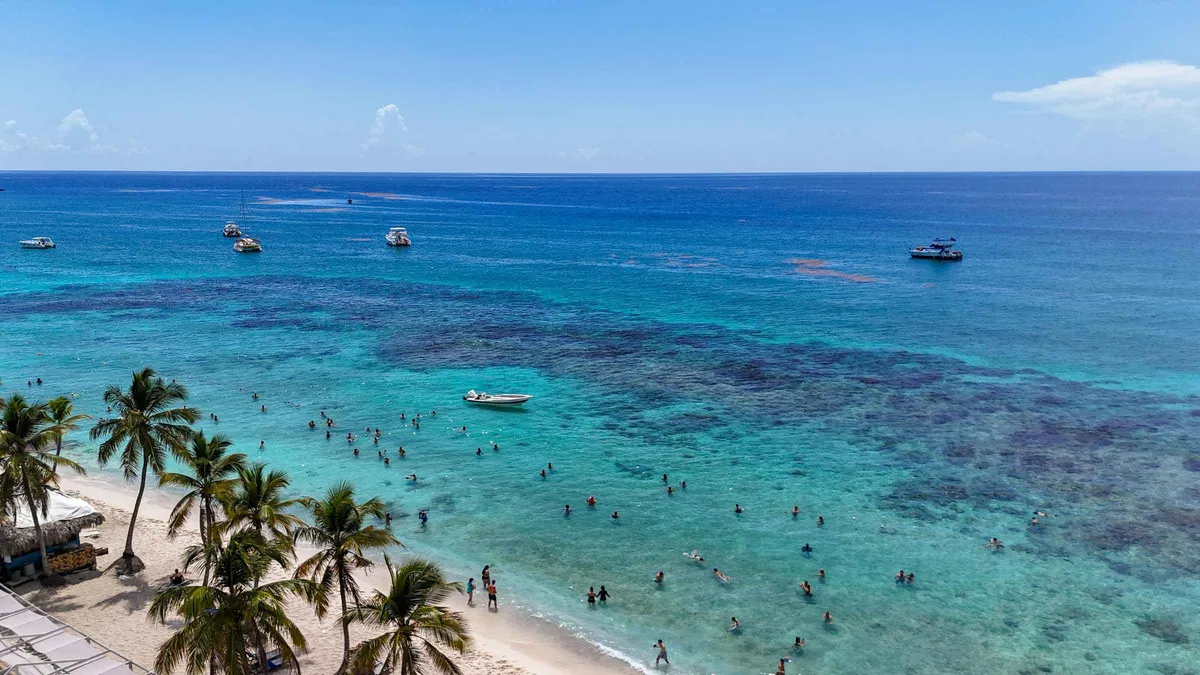
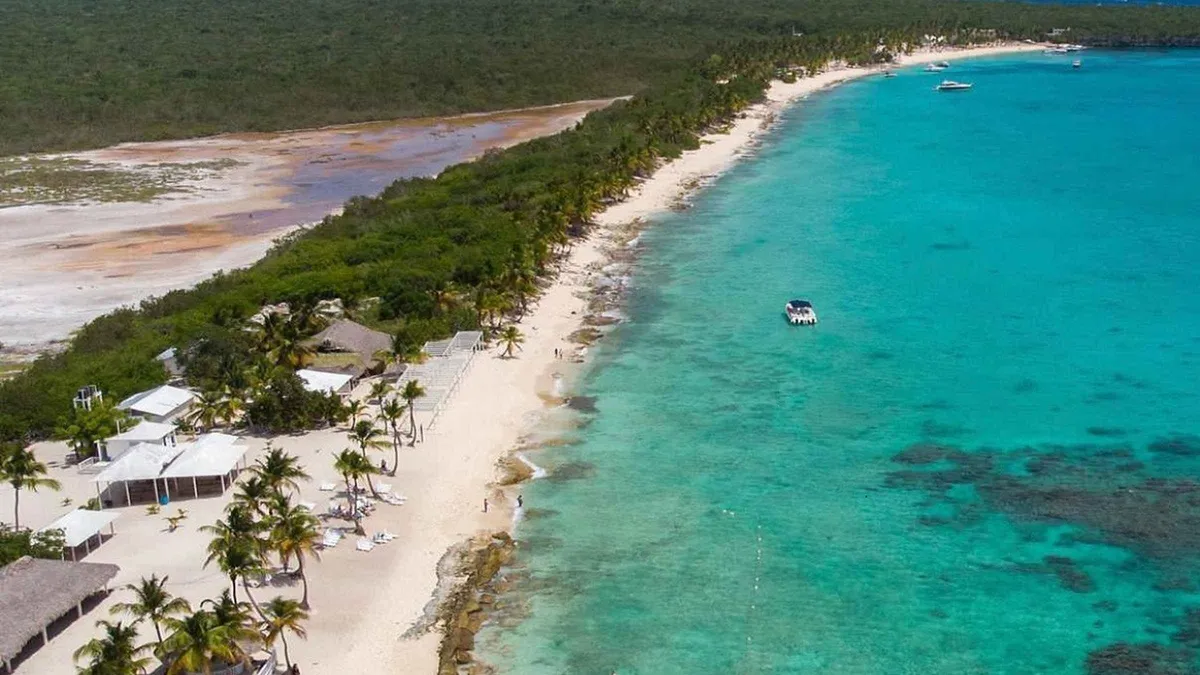
Coral limestone, 9.6 km² (3.7 sq mi), three overlapping plateaus, and a high point of just 18 m (60 ft) — low enough that from the water the island reads as a green line above a white one. Sand dunes, mangrove and reef sit inside the boundary, and the shallows are wide: natural sandbars offshore bring the depth down to a few feet in places, which is exactly why the beginner snorkel site works. Columbus named it Santa Catalina in May 1494.

Nobody lives there. The only built thing on the Ministry map is an airstrip, the Aeródromo de Catalina Island, drawn across the middle of the island.

What You Actually See: The Wall, The Aquarium and a Pirate Ship

The two sites every boat visits are named on the listings, and they are not interchangeable. One is a drop-off for people who are comfortable in deep water; the other is a shallow garden where a first-timer can stand up mentally, if not literally.

The Wall — the deep one

La Pared, the first stop the dive boats make out of Bayahibe. The Dominican tourism board calls it "the over 100 ft Catalina Wall", and the Ministry map's soundings show why: the shelf the boats moor on reads around 9 to 10 m, then the contour lines crowd together and fall to the 100 m line offshore. You snorkel the top of that edge, not the bottom of it.

Visibility around Bayahibe can exceed 20 to 30 m, which is what makes a wall worth snorkelling rather than only diving — the shape of the thing is visible from the surface. The trip with two hours in the water is the only listing that gives a working depth for the mooring, about 30 ft.

The Aquarium — the shallow one

El Acuario, the second stop, about five minutes further on from The Wall. About 13 ft deep, sand-bottomed between coral heads, and the stop that beginners are usually taken to second, once they have found out whether the mask leaks. Three of the set listings send you here; the two cheapest describe a single unnamed "coral reef stop" on the crossing, which in practice is this one.

Captain Kidd's ship, in ten feet of water

The pirate William Kidd abandoned his 1699 prize, the Quedagh Merchant, off this island and was hanged in 1701 without telling anyone where. An Indiana University team found it on 13 December 2007 at 3 m (10 ft) depth, roughly 70 m (230 ft) offshore. It is now a marine protected area and a nominated "Living Museum in the Sea"; one of the twenty-six cannons found on the wreck is on display in Indianapolis.

Note the numbers before you go looking: the tourism board's page says the wreck lies "at 70 feet", which reads the offshore distance as a depth. It is snorkel-shallow, and that is the entire point of it — it is one of the few pirate wrecks on earth a swimmer can look at.

The wider dive map

Bayahibe and La Romana together are the Dominican Republic's main dive destination — more than 20 official dive sites off this stretch of coast, with Catalina Wall and the Aquarium named among the emblematic ones by the Ministry of Tourism. Two wrecks sit within reach of the same boats but well below snorkelling depth: the St. George, a 73 m cargo ship sunk in 1999 at 30 to 40 m, and the Atlantic Princess, sunk in 2009 at about 12 m. If you are a certified diver, book a dive day; none of the trips on this page will take you down.

Where the Boats Leave From, and How Long the Crossing Takes

Isla Catalina has no dock, no ferry and no scheduled service. Four departure points feed it, and the difference between them is an hour and a half of road each way — the single biggest variable in how long your day is.

Four ways to the water

Bayahibe is the closest working port and the one nearly every boat actually sails from; a Punta Cana pickup means an 80 to 90 minute coach transfer to reach it or the La Romana cruise terminal first, then the crossing on top. Crossing times below are the operators' own figures, read from the listings in September 2026, and they vary more by hull than by distance.

Departure pointCrossingRoad transferTrips that use it
Bayahibe village and marinaAbout 1 hour by catamaran, 30 minutes by engine boatNone if you are staying locallySmall-group day, Quetzal catamaran
La Romana cruise portAbout 30 minutes by engine boatMinutes from La Romana hotelsAll-inclusive day, Full day from Punta Cana
Los MelonesAbout 2 hours each way on the slowest catamaran10-minute van hop to the marinaComfort catamaran
Punta Cana hotelsAs above, once you reach the coast80 to 90 minutes each wayThree of the set listings

What that does to the day

The arithmetic is unforgiving: the 11-hour listing picks up between 07:00 and 08:00 and returns around 18:00, of which roughly three hours are road. The 7.5-hour catamaran sails at 09:00 and is back in Bayahibe about 16:30, but budgets two hours each way on the water. If you are staying in Bayahibe or Dominicus, you are buying back three hours of your life by booking a trip that starts at the marina rather than one that starts at a Punta Cana lobby.

Can You Snorkel Catalina Island Without a Tour?

This is the most-asked question about the island and it has an unusually clean answer: no, and not for a commercial reason.

There is no shore to walk in from

The island is 2.4 km offshore and uninhabited. There is no ferry terminal, no public boat, no beach you can drive to and no snorkel-only ticket sold anywhere. Every visit is a boat trip that someone organises — an excursion, a dive charter or a private hire — and the protected-area admission is bundled into the fare rather than sold at a gate.

That makes the comparison on this page a comparison of boats and hours, not of tickets, and it is why a cheap listing is not a cheaper way in: it is a shorter time in the water.

The one alternative worth knowing

If you have your own group, local boats can be hired privately out of Bayahibe, and Bayahibe's dive centres run charters to the same two sites for certified divers. Neither is cheaper for two people, and neither includes the buffet and open bar that the day trips build their price around. What a private charter does buy is your own clock — arriving at The Wall before the excursion fleet, which on a busy morning is the difference between a reef and a queue.

What Your Ticket Actually Pays For

Every listing on this page says the park fee is included, and none of them says how much it is or who receives it. Here is what sits behind that line, with the sources.

A protected-area admission, folded into the fare

Isla Catalina is a protected area of the Dominican state, administered by the Ministry of Environment and Natural Resources, and visitors are counted at it: Isla Catalina and Isla Saona between them recorded more than one million visitors in 2025 — 42% of every registered visit to a Dominican protected area, according to Ministry of Environment statistics quoted by the Ministry of Tourism in its March 2026 report on Bayahibe. The admission is collected through the operators rather than from you, which is why no listing quotes it separately and why nobody at the beach will ask you for money. The boundary it pays for is drawn on the Ministry of Environment's own map sheet, the one that gives 16.23 km² and the 300 m buffer.

What else is inside the fare, and what is not

All listings include the protected-area admission, snorkel gear, lunch and an open bar; all five allow free cancellation up to 24 hours before pickup and take no payment at booking. What sits outside the fare varies and is worth reading: the all-inclusive day charges separately for professional photographs, extra dishes and anything outside the open bar; the comfort catamaran excludes tips and personal spending; the Quetzal cannot be booked through the platform at all by Club Med Punta Cana guests, who must use the resort's own desk. Sunbeds are included where the beach has them, and at least one operator hands out beach towels — check the inclusions list rather than assuming.

When the Water Is Clearest, Month by Month

Bars show the sea-surface temperature at the island in Celsius, averaged from daily maxima over the twelve months to August 2026 (Open-Meteo Marine, ERA5). Rainfall and wind figures below come from the 2021–2025 ERA5 archive for the Bayahibe coast.

The water never falls below 27 °C: the coldest month on this record is March at 27.1 °C (81 °F) and the warmest September at 30.3 °C (87 °F). Nobody needs a wetsuit here in any month, which is the plainest difference between this island and the other Catalina. What the calendar does change is the crossing — February carries the windiest daily maxima on the 2021–2025 record at 21.3 km/h, and reviewers on the rougher days describe the boat ride, never the reef, as the hard part. If a swell is running and you are prone to seasickness, take the tablets before you board rather than after.

The Cruise-Ship Calendar Nobody Checks

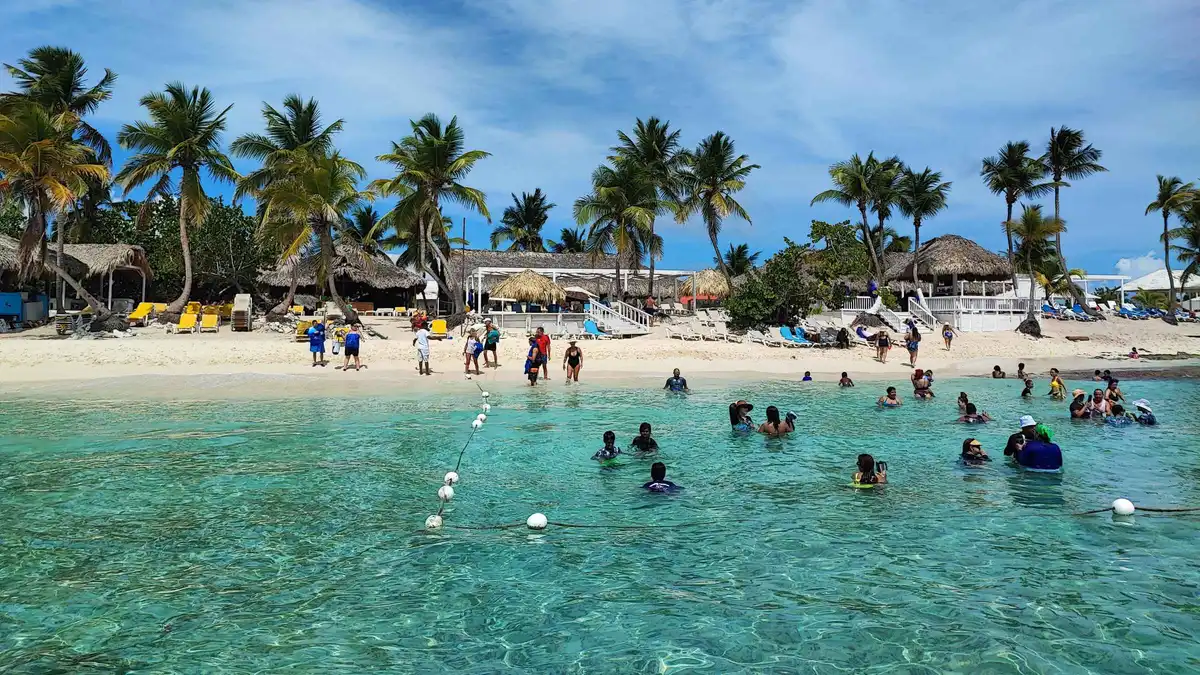
Isla Catalina is a cruise stop as well as a snorkel stop, and the two share one beach. Ships have no dock here — they anchor offshore and tender passengers ashore — so on a call day a few thousand people arrive on the sand between roughly 08:00 and 17:00.

What is coming, and when

MSC's private-beach development on the island, Catalina Sugar Beach, opens in November 2026, and MSC Opera calls weekly on its new La Romana round-trips, with Explora Journeys on selected voyages. The listed calls below were read from the port schedule in September 2026 and are the shape of a normal month once the beach opens. Costa Cruises has anchored off the island for its own beach day for years.

DateShipLineAshore
17 November 2026MSC OperaMSC Cruises07:00 – 17:00
19 November 2026MSC Explora 3Explora Journeys08:00 – 17:00
24 November 2026Mein Schiff 5TUI Cruises07:00 – 18:00
29 November 2026MSC OperaMSC Cruises08:00 – 18:00
30 November 2026Marella DiscoveryMarella Cruises08:00 – 18:00

How much it actually matters

Less than you would fear, if you pick the right trip. The snorkel sites are offshore moorings on the far side of the island from the cruise beach, and a ship's tender operation does not touch them — what a call day changes is the beach hours, the queue at the buffet and the noise. So the practical advice runs the other way from the usual: if your date coincides with a call, book the trip that keeps you on the water longest and ashore least. Two hours in the water and lunch at a beach restaurant or lunch served on the catamaran both dodge the crush that a day built around beach time walks straight into.

Check the date on a port schedule before you book; it takes a minute and it is the single most useful thing you can do for a Catalina day.

Catalina or Saona — Which Island to Give the Day To

The two islands leave from the same port, cost about the same and are sold by the same operators, so travellers ask which is better. They are not competing at the same thing.

The reef day against the beach day

Between them they took more than a million visitors in 2025. Saona is far larger, has villages and palm-backed beaches that run for kilometres, and its centrepiece is the piscina natural — a waist-deep sandbar offshore where the boats stop and everyone stands in the sea with a drink. Catalina is smaller, emptier and reef-first: two named sites, a wall you can see the shape of from the surface, and a wreck in ten feet of water.

If your day is about the snorkelling, it is Catalina. If it is about the beach, it is Saona, and no amount of comparison will change that.

Isla CatalinaIsla Saona
The drawTwo named reef sites and a pirate wreckA vast beach and the natural swimming pool sandbar
Crossing from Bayahibe30 minutes to 1 hourAround 1 hour by speedboat, longer by catamaran
Time in the waterSnorkelling is the itineraryA sandbar stop, snorkelling optional
CrowdsA cruise beach on call days, quiet otherwiseConsistently the busier of the two
Best forAnyone who came to look underwaterAnyone who came to lie down

What to Bring, and What the Boat Hands You

The inclusions overlap heavily, so the packing list is short — and two of the items on it are there because of the protected-area rules rather than comfort.

Supplied on every listed trip

Mask, snorkel and life jacket; lunch; an open bar of water, soft drinks, beer and rum; and the protected-area admission. Beyond that it varies: the small-group day hands out beach towels and runs a photography service, the comfort catamaran has sunbeds and bathrooms on its stretch of beach, and the Quetzal serves lunch on deck rather than ashore.

Bring it yourself

Reef-safe sunscreen — you are swimming inside a protected area over living coral, and the shallow site is only about 13 ft deep, so whatever comes off you goes onto it. Water shoes or sandals you can take off, because several boats are boarded barefoot and one is reached by taxi boat. Dry clothes in a bag, since the return leg is wet and windy.

Cash for tips and the coconut sellers, which no listing covers. And motion-sickness tablets if you are at all prone: take them before boarding, not when the swell starts.

Who the listings will not carry

Access rules differ sharply and are stated on each listing rather than shared across them. The small-group day is listed as wheelchair accessible. The Quetzal is not suitable for people with mobility impairments and is boarded via a taxi boat. The comfort catamaran does not accept pregnant women. The full day from Punta Cana does not accept wheelchair users, travellers with back problems, or anyone over 70. The all-inclusive day will not take babies under one year. If any of that applies, it decides the booking before price does.

What Travellers Said After the Day

★★★★★ ★★★★★
I've done the best snorkeling of my life. The food on the island is really good.
Patricia Toral · Spain · August 2025
★★★★★ ★★★★★
Christian did a really good job explaining everything and keeping all people safe and entertained.
Yuliya · Canada · February 2025
★★★★★ ★★★★★
Breathtaking views at sea and on land on Catalina Island. The definition of a day in paradise.
Stéphane · France · August 2025
★★★★★ ★★★★★
The island has some mesmerising views with white sand and crystal clear waters. The buffet was also pretty good.
Amine · Morocco · August 2026
★★★★★ ★★★★★
Excellent activity. Very good communication with the service provider. The buffet was excellent.
benoit · France · April 2026
★★★★★ ★★★★★
The people are very friendly and the organization is excellent. The island is wonderful. It's really worth it.
Benedetta · Italy · August 2026

Short excerpts from verified GetYourGuide reviews of the trips listed on this page, with their original dates. The full reviews sit on each operator's listing.

Choosing a Catalina Island Snorkeling Trip

Does Catalina Island have good snorkeling?

Yes, and it is the reason the island is on excursion itineraries at all. The Ministry of Tourism names Catalina Wall and the Aquarium among the emblematic sites of the country's main dive region, where visibility can exceed 20 to 30 m. The Wall is a drop-off described as over 100 ft; the Aquarium is a shallow reef at about 13 ft. Both are moorings, so you enter from the boat.

Where is the best snorkeling spot on Catalina Island?

It depends what you swim like. Confident swimmers get more from The Wall, where a shallow coral terrace of roughly 1.5 to 6 m runs to a lip and the reef edge falls away beneath it. Anyone nervous in open water should prioritise a trip that includes The Aquarium, the shallower of the two at about 13 ft over sand. Two of the listed trips visit both sites in one day.

Can you snorkel at Catalina Island for free?

No. The island is 2.4 km offshore, uninhabited and protected, with no ferry, no public boat and no shore entry to buy. Every way in is an organised boat trip or a private charter, and the protected-area admission is folded into the fare rather than sold at a gate.

How long is the boat ride to Catalina Island?

About 30 minutes by engine boat from La Romana and roughly an hour by catamaran from Bayahibe, with one listed catamaran budgeting two hours each way. Punta Cana hotel pickups add 80 to 90 minutes of road in each direction on top of that. Full crossing table.

When is the best time of year for a Catalina Island snorkeling trip?

December to March. Rainfall runs 19 to 37 mm across 7 to 10 rainy days in that window, against 128 to 137 mm across 19 rainy days in September and October at the hurricane-season peak. Water temperature is not a factor — it stays between 27.1 °C and 30.3 °C all year. Month by month.

Which is better, Saona Island or Catalina Island?

They answer different questions. Catalina is the reef day: two named snorkel sites and a pirate wreck in ten feet of water. Saona is the beach day, built around a waist-deep natural swimming pool on an offshore sandbar. If you came to look underwater, it is Catalina. The full comparison.

How far in advance should a Catalina trip be booked?

Far enough to pick your date rather than take what is left, since every trip listed here are free to cancel up to 24 hours before pickup and take no payment at booking — there is no cost to booking early. The dates worth reserving first are in the December-to-March dry window, and any date that does not coincide with a cruise call.

Do you need to be able to swim?

Life jackets are supplied on every listed trip and both sites are entered from the boat, so non-swimmers do go in. What differs is exposure: The Wall is a drop-off in open water, while the Aquarium sits over sand at about 13 ft. Anyone uneasy in deep water should choose a trip that includes the shallow site and stay near the boat at the other.

Pick the trip by how long it leaves you in the water, then pick a date that does not share the beach with a cruise ship.

The December-to-March dry window books out first

Free cancellation up to 24 hours before pickup on every trip listed here, with nothing paid at booking.

Check Availability
Tours from $69 Check Availability